
Glaucoma in Singapore: Everything you need to know about the condition that steals vision without warning
Glaucoma is often called the “silent thief of vision” because the most common forms can gradually damage eyesight without causing obvious symptoms in the early stages.
You may have no pain, no redness and no noticeable blur. Central vision can remain relatively good while damage develops elsewhere in your visual field. By the time you realise that something is wrong, some vision may already have been permanently lost.
This is why glaucoma screening is an important part of eye care in Singapore, particularly as we get older or if we have additional risk factors.
Understanding glaucoma is not only about preventing blindness. It is also about preserving the vision you rely on for driving, walking safely, navigating crowded places and maintaining independence.
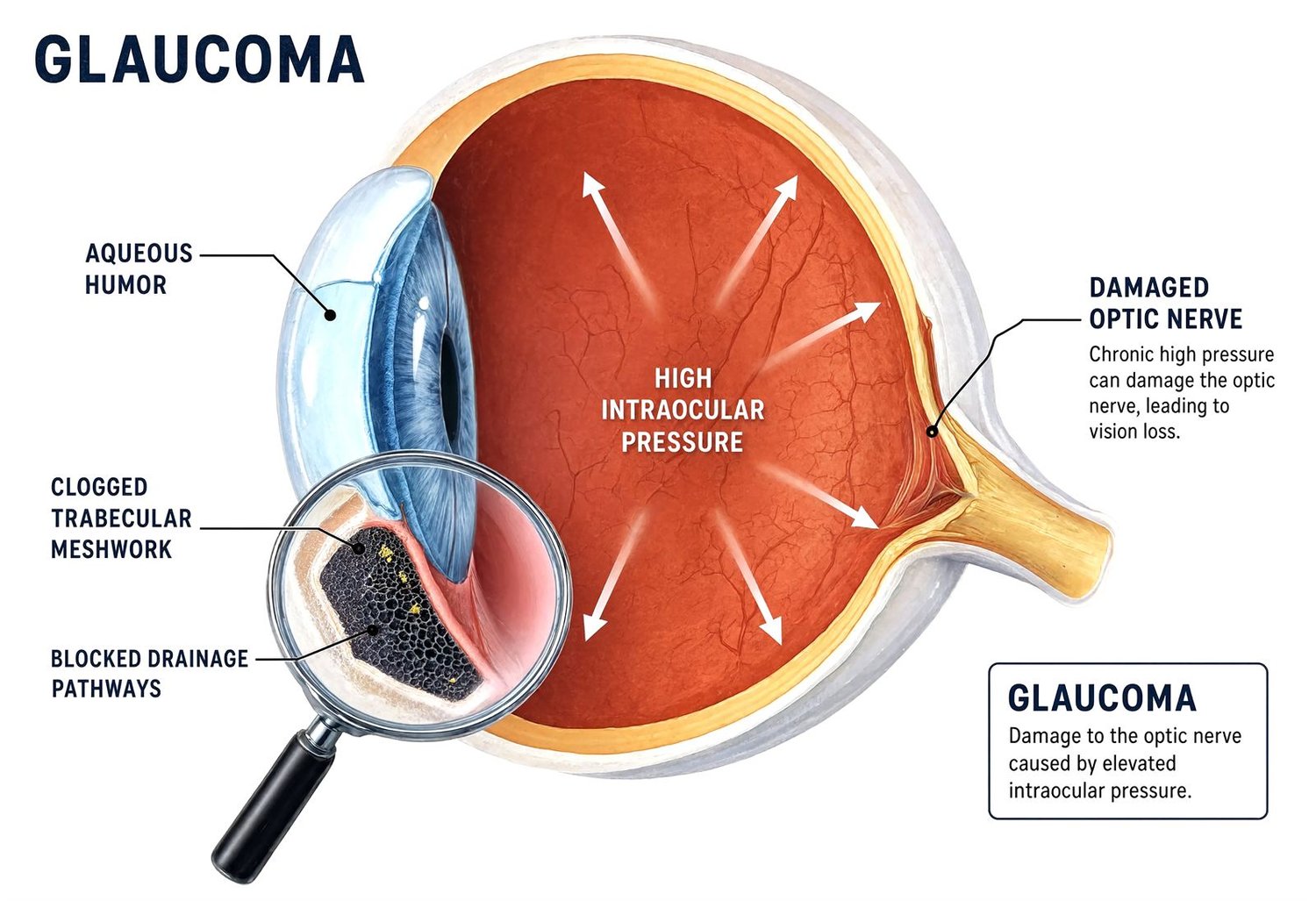
Table of Contents
- What glaucoma is and what it is not
- Why Glaucoma can be dangerous in Singapore’s ageing population
- The lifestyle impact: How peripheral vision loss affects daily activities
- Who is at higher risk of developing glaucoma?
- How glaucoma is diagnosed in Singapore
- Treatment options: Eye drops, laser and surgery
- Schedule a glaucoma screening at Eye Max Centre
What glaucoma is and what it is not
Glaucoma refers to a group of eye diseases that cause progressive damage to the optic nerve, which carries visual information from the eye to the brain.
Eye pressure, or intraocular pressure (IOP), is an important risk factor for glaucoma but glaucoma is not simply “high eye pressure”.
Some people have elevated eye pressure without detectable glaucomatous optic nerve damage, while others develop glaucoma even when their eye pressure falls within a statistically normal range.
There are also different forms of glaucoma, including open-angle glaucoma, angle-closure glaucoma and secondary glaucoma.
An eye specialist in Singapore therefore considers more than your eye-pressure reading when assessing your risk.
Why Glaucoma can be dangerous in Singapore’s ageing population
Age is an important risk factor for glaucoma. As Singapore’s population ages, detecting chronic eye diseases such as glaucoma becomes increasingly important.
The challenge is that glaucoma-related vision loss is generally irreversible. Treatment aims to protect the remaining vision by slowing or preventing further damage rather than restoring optic nerve tissue that has already been permanently damaged.
Regular examinations at an eye clinic in Singapore can therefore be particularly important for older adults and people with additional glaucoma risk factors.
Early diagnosis gives your eye doctor in Singapore an opportunity to monitor or treat the disease before extensive visual-field loss occurs.
The lifestyle impact: How peripheral vision loss affects daily activities
Glaucoma is sometimes misunderstood as simply causing “blurry vision”. In reality, progressive loss of the visual field can affect how you interact with the environment around you.
You may still be able to read letters on a standard vision chart while having difficulty noticing objects or movement towards the sides of your vision.
Driving safely with glaucoma
Driving requires more than sharp central vision.
You also need peripheral awareness to notice pedestrians, cyclists, other vehicles and objects approaching from different directions.
As glaucoma progresses, visual-field loss may make these tasks more difficult. People with established glaucoma should discuss driving with their ophthalmologist, particularly if visual-field testing shows significant loss.
Whether someone can drive safely depends on the extent of their visual impairment and applicable licensing requirements, not simply the diagnosis of glaucoma itself.
Navigating stairs, crowds, and low-light environments
Peripheral visual-field loss can also affect everyday mobility.
Someone with more advanced glaucoma may have difficulty noticing obstacles, steps or people approaching from the side. Navigating crowded shopping centres or unfamiliar environments may become more challenging.
Low-light conditions can present additional difficulties for some patients.
These changes often develop gradually, which means a person may adapt without immediately recognising how much their field of vision has changed.
Who is at higher risk of developing glaucoma?
Anyone can develop glaucoma, but certain factors increase the likelihood.
Family history
Having a close family member with glaucoma can increase your risk.
If a parent or sibling has glaucoma, tell your eye doctor in Singapore. Your family history may influence how frequently your optic nerves, eye pressure and visual fields should be assessed.
A family history is especially relevant because relatives can share anatomical and genetic factors associated with glaucoma.
High myopia and glaucoma risk
People with high myopia, or severe short-sightedness, have an increased risk of certain forms of glaucoma.
High myopia can also change the appearance of the optic nerve and surrounding structures, sometimes making glaucoma assessment more complex.
If you are highly myopic, a comprehensive examination should therefore involve more than simply checking whether your spectacle prescription has changed.
Race and anatomy: Why Chinese and Indian Singaporeans have different risk profiles
Singapore’s multi-ethnic population makes glaucoma screening particularly interesting because the prevalence of different glaucoma subtypes can vary between populations.
People of Chinese and other East Asian backgrounds have an important risk of angle-closure disease, partly because anatomical characteristics of the front of the eye can predispose susceptible individuals to narrowing or closure of the drainage angle.
Open-angle glaucoma is also an important consideration among Indian and other populations in Singapore.
Ethnicity alone does not determine whether you will develop glaucoma. Your eye specialist in Singapore will consider your individual eye anatomy, age, family history, eye pressure, optic nerve appearance and other factors when assessing risk.
How glaucoma is diagnosed in Singapore
There is no single test that diagnoses every case of glaucoma.
A comprehensive glaucoma assessment may include measurement of eye pressure, examination of the optic nerve, assessment of the drainage angle, measurement of corneal thickness and tests that evaluate structural and functional changes.
Intraocular pressure: Why normal pressure does not rule it out
Tonometry measures the pressure inside your eye.
Elevated intraocular pressure is an important glaucoma risk factor, but a normal reading does not guarantee that glaucoma is absent.
Some people develop glaucomatous optic nerve damage at pressures that fall within the normal statistical range. Eye pressure can also fluctuate throughout the day.
For this reason, glaucoma screening at an eye clinic in Singapore should not consist solely of a quick pressure check.
Visual field test and OCT imaging
A visual field test measures your ability to detect lights at different locations within your field of vision. It can identify patterns of functional vision loss associated with glaucoma.
Optical coherence tomography, or OCT, provides detailed images and measurements of structures such as the retinal nerve fibre layer and optic nerve.
Your ophthalmologist can compare these findings over time to look for progression.
Structural imaging and visual-field testing complement each other, allowing your doctor to assess both physical changes to the optic nerve and their effect on visual function.
Treatment options: Eye drops, laser and surgery
Glaucoma treatment primarily aims to lower intraocular pressure sufficiently to reduce the risk of further optic nerve damage.
For some patients, treatment begins with prescription eye drops. These medications lower pressure either by reducing fluid production inside the eye or improving its drainage.
Laser treatment may also be appropriate. For example, selective laser trabeculoplasty (SLT) can be used for selected people with open-angle glaucoma or ocular hypertension.
Other forms of laser treatment may be used for particular types of glaucoma, including angle-closure disease.
When glaucoma cannot be adequately controlled with medication or laser or when the disease is sufficiently advanced, surgery may be considered. The appropriate procedure depends on the type and severity of glaucoma and the individual characteristics of the eye.
Whichever treatment is chosen, glaucoma usually requires long-term follow-up. Feeling that your vision is unchanged does not mean that treatment or monitoring is no longer necessary.
Schedule a glaucoma screening at Eye Max Centre
You do not need to wait until you notice vision loss before having your eyes checked for glaucoma.
If you are older, highly myopic, have a family history of glaucoma, have previously been told that your eye pressure is elevated, or simply have concerns about your glaucoma risk, a comprehensive eye assessment can provide a clearer picture of your eye health.
At Eye Max Centre, your eye specialist in Singapore can assess your eye pressure, optic nerves, drainage angles and other relevant risk factors. Where appropriate, additional investigations such as OCT imaging and visual-field testing can be performed.
If glaucoma is detected, your eye doctor in Singapore can discuss whether monitoring, eye drops, laser treatment or surgery may be appropriate for your condition.
Whether you found Eye Max Centre while searching for an eye clinic in Singapore, Singapore eye care, or a Singapore vision centre, the important principle remains the same: glaucoma is best detected before you notice the vision it has taken.
Because when glaucoma is truly “silent”, regular eye examinations may be the only way to hear the warning.
To schedule an appointment, contact Eye Max Centre at +65 6694 1000 or manager@eyemax.sg.
